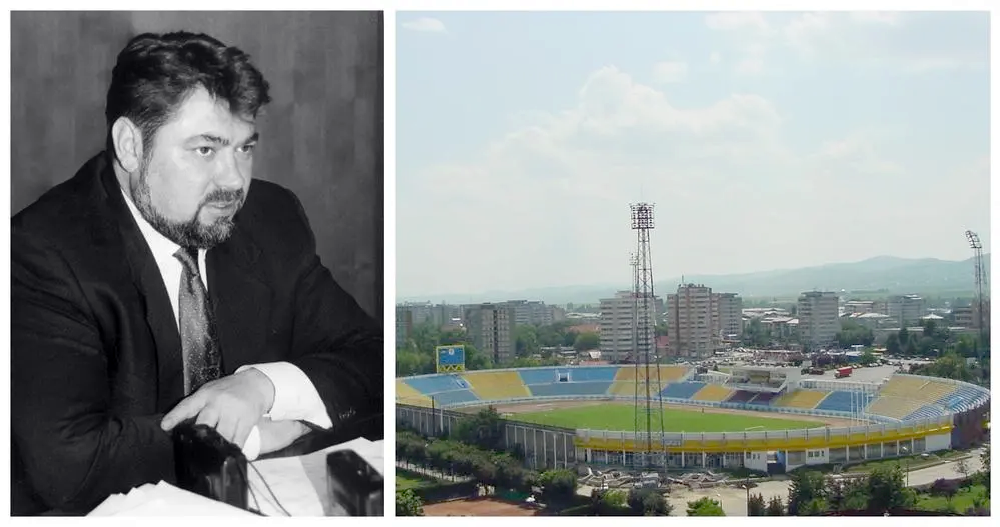
In the heart of this summer, Dumitru Sechelariu would have turned 67. And the football flagship of Bacău, funded by him for two decades, would be celebrating 76 years of existence this autumn.
Sign
They say you can’t change destiny. Or can you? On July 14, Dumitru Sechelariu would have turned 67. But the thread of his life was much shorter. Too short, unjustly short. It snapped before he even reached 55, on a winter day—February 16, 2013. The end of a road. But not the end of a story. The man who served as mayor of Bacău between 1996 and 2004 remains—today and always—a neverending story. A story retold time and again. Always the same, yet never identical, because the pages keep flipping back and forth, and those who leaf through them each have their own way of understanding and narrating them. A life story. With highs and lows, about a man with highs and lows—like life itself. And the good outweighed the bad. Clearly so.
On the day Dumitru Sechelariu was laid to rest, the weather acted up. In a way, it resembled the temperament of the former mayor—well-known for his contrasts. That morning was wrapped in thick, cold fog, followed by a sharp, biting wind, as if February was showing its true face. Around noon, as the funeral procession approached the City Hall building—then still located at 6 Mărășești Street—the wind blew away the clouds, and a warm, spring-like sun cast its rays over the city. This isn’t just journalistic embellishment meant to evoke nostalgia. That’s exactly how it happened. Anyone present—of whom there were many—surely remembers that day’s dramatic weather. Just as hard to forget is the moment when people along the streets, at their windows, and on balconies began to applaud the passing of the cortege. A sign of appreciation for a man with both faults and merits—Dumitru Sechelariu. And most of all, a sign that most of Bacău’s people saw Seche as a good man. And one who loved people.
When, sometime in the late ‘90s, a well-known journalist from the national press asked what title would best suit a film about his life, Sechelariu didn’t hesitate:
“Love and Destiny.”
Love
Destiny gave Dumitru Sechelariu a love for sports—especially football. Thus, his destiny became intertwined for two decades with that of FCM Bacău. In fact, it was the team’s final two decades—founded on September 4, 1949, as Dinamo Bacău, and fading from the scene in 2012. In the fall of 1992, when he decided to take over the club, Sechelariu was one of Romania’s most successful businessmen. And through his company, Selena, he had already done memorable things for sports—achievements that remain impressive to this day.
First, the national women’s handball championship title won by Știința Bacău in 1992—the last one in their trophy case to this day. Then, the revival of Francisc Vaștag’s boxing career, culminating in European and world titles in 1993. For the city’s football team, then on the verge of collapse, Sechelariu ensured, above all, survival. He gave the team a future. But first, he gave it a name—since it had lost its identity entirely. A name with resonance. The name of his company: Selena.
„Without Doru Sechelariu’s involvement, Bacău’s team would have disappeared completely at the start of the ‘90s,” stated—more than once—Corneliu Costinescu, a leading figure in both local and national football.
In that inaugural 1992–93 season, Selena Bacău didn’t manage to avoid relegation. But they did achieve one of the most stunning results in top-flight history: a 1–0 away win against Dinamo Bucharest, courtesy of a goal from Sorin Condurache—who himself left us far too early. That upset—”the bombshell of the season,” as newspapers called it—cost Dinamo the championship title. The Bucharest side didn’t take it lightly and made sure Bacău was relegated.
Selena spent two seasons in the purgatory of the second division. But when they returned to the top tier in 1995, they came back to stay—and to write history. One notable page, under the name AS Bacău, was penned in August 1996. Another „bombshell”—the bombshell of bombshells—was detonated in Ghencea, where Bratu, Jercălău, Gireadă, Popovici, Radu Ciobanu, Dănuț Munteanu, Rotariu (min. 84 Giani Căpușă), Florin Pavel, Manta (min. 80 Păvăluță), Serea (min. 82 Condurache), and Scânteie, under coaches Mircea Nedelcu and Mircea Pană, defeated reigning champions Steaua with an unbelievable 5–1 (Jercălău with two penalties, a wonder strike from Pavel, and two goals by Scânteie; Steaua’s consolation by Ciocoiu). A true sign of destiny.
Names
For 11 uninterrupted seasons—from 1995 to 2006—Seche’s Bacău remained in Romania’s top league, officially named Fotbal Club Municipal (FCM) from 1997. Glorious years. With top-tier coaches and players. With Dumitru Sechelariu as honorary president and the club’s driving force, FCM Bacău became a cradle of names.
Coaches—from veterans like Mircea Nedelcu, Florin Halagian, Viorel Hizo, Vasile Simionaș, and Țiți Dumitriu, to rising bets like Costel Orac, Ilie Dumitrescu, and Ionuț Lupescu; from new-wave tacticians like Marian Mihail and Mircea Rednic to local talents like Ghiță Poenaru and Cristi Popovici.
Players—some homegrown and once-unknown, who made their names in Bacău: Cristi Ciocoiu, Florin Petcu, Vlăduț Munteanu; followed by Andrei Cristea, Florin Lovin, Alex David, and Dragoș Huiban—who, just this summer, helped Metaloglobus Bucharest achieve historic promotion. Others came with no name, but left with one: Narcis Răducan, Răzvan Raț, Cătălin Cursaru, Vali Bădoi, Marius Croitoru, Dorin Goian. And others were brought precisely because of their name: Costel Pană, Florin Prunea, Răzvan Lucescu, Adi Pitu, Nivaldo, Daniel Iftodi, Iulian Miu, Zeno Bundea.
The list goes on. And it would be unthinkable without Dumitru Sechelariu. Just as the club’s only senior-level national trophy would’ve been impossible without him: the League Cup, won in 1998 after a 3–2 final against Universitatea Cluj, at “Rocar” Stadium.
Two years later, in 2000, FCM came close to repeating the feat, losing the final to Gloria Bistrița on a June evening at “FC Național” Stadium in the „Park of Plane Trees.” Between those two League Cup finals came the club’s 1999 UEFA Intertoto appearance, where Bacău—coached by Halagian and Chivorchian (plus “Sechelarian,” as Seche jokingly introduced himself at the official dinner in Yerevan)—fell to Ararat Yerevan.
Maybe it wasn’t that much. But it was certainly not little—especially when viewed from today’s perspective.
Snapshots
Let’s rewind and fast-forward through the two decades in which football in Bacău lived alongside Dumitru Sechelariu, stopping at a series of frames. In black and white and in color—naturally, yellow and blue.
So then… The Skala brothers, the first foreign twins in the history of Divizia A. The unbelievable 1-0 victory on Dinamo’s pitch. The years in Division B. And the arabesques of Narcis Răducan, “the wonder child, Răducan they call him.” Seche shooting a pistol in Moreni, Seche kneeling in Brăila and swearing he would bring Bacău back to Division A, Seche happy for bringing Bacău back to Division A in the summer of ’95. Ciocoiu’s superb goal against Steaua—a goal worth… a transfer to the military team.
The tragic loss of Nicu Păduraru. The humiliation in Cluj: 1-7 with “U”. The supercalifragilistic 5-1 in Ghencea against Steaua with Prodan and Filipescu, Adi Ilie and Lăcătuș. The sensational second half of the 1996-97 season, with Nelu Crețu as president, a half worthy of a UEFA qualification, with home wins against the giants Steaua, Dinamo, and Rapid, and referee-dictated defeats at Piatra Neamț (fiefdom of “Pinalti” Ștefan) and Bistrița (den of “Tata Jean” Pădureanu). “Chivorchian, Chivorchian, the biggest boss of them all!”
Halagian and “fire at them, money to us.” The penalty scored by Sorin Trofin that cost Mircea Lucescu’s Rapid the championship title in 1998. The League Cup win. Cursaru’s CNN-worthy strikes in his debut top-flight matches, foretelling the later overhead kick against Dinamo and his top-scorer title. The play-off lost on penalties against Farul. The transaction with FC Baia Mare.
The floodlights inauguration, with a Holograf concert and stands packed to the brim with banners: “Our heart will always be yellow and blue,” “Thank you, Seche,” “The raging bulls.” The win over the UEFA Super Cup holders, Galatasaray Istanbul, in a luxury friendly. Andrei Cristea’s hat-trick against Craiova before he even turned 20.
Vertigo: from fifth place and the lure of European cups to the threat of relegation—avoided, two seasons in a row, in the final round. The “FCM Bacău plays for you” campaign, run in 2007 in the second division under the Flaviu Pop–Marius Căpușă duo, with the funds donated to the Pediatric Department of Bacău Hospital for its complete refurbishment. More years in Division B. And one in Division C, at the express command of Bacău’s City Hall. A season in Division C at the end of which Seche’s FCM, against all odds, would win the promotion battle with ASC—the clone on which the city hall burned through millions of euros in public funds.
Finally, the last league match in FCM Bacău’s history: 4-0 against Dunărea Galați in June 2012. And then 2013, the year of bad luck. Just to remember what we had and what we lost. But also what we gained.
Vision
Speaking of perspective. One of Sechelariu’s main qualities—beyond his proverbial generosity—was his ability to always look far ahead. Very far ahead! He was considered a visionary, including in football. After all, Seche was the first exclusive financier of a Romanian top-division football team after 1989. It was also thanks to him that the first stadium with floodlights in Moldova appeared.
And when the stadium was modernized and equipped with floodlights in 2001, the Bacău arena entered the Top 3 in Romania in terms of facilities. For a long time, “Municipalul” remained one of the most stylish and appreciated stadiums in the country.
Seche was also the first to see the opportunity of… buying a top-division spot! It happened after the controversial play-off lost by FCM Bacău to Farul Constanța at the end of the 2000–2001 season, a match that had led to the yellow-and-blues’ relegation to the second division. A second division they remained in for only… eight days, as Sechelariu struck a deal with Heinrich Schorsch, owner of FC Baia Mare, to purchase their top-division place and thus bring Bacău back to the elite in record time. A less-than-orthodox move, but perfectly legal.
Dumitru Sechelariu was also behind the famous “Zero Moment” in Romanian football. In the early 2000s, Seche proposed that first-league club leaders stop playing matches with pre-agreed results—the notorious match-fixing done by the even more notorious “Football Cooperative.” And on July 14, 2002, Sechelariu launched “Generosity Sunday,” a charitable event that filled Cancicov Park to the brim. Criticized at the time, the concept turned out to be ahead of its time, given that today it continues to be replicated and is widely promoted.
Finally, it was Sechelariu who had the original idea of including special clauses in the transfer agreements of Eugen Baciu and Florin Lovin to Steaua. Specifically, Steaua was obliged to pay FCM a certain sum when the two players reached the end of their contracts with Gigi Becali’s club. In this way, Seche had envisioned a financial safety net in case another clause—regarding a percentage of any future transfer—was not activated.
It’s well known that in the end, in the “Baciu case,” Seche’s ingenuity brought FCM Bacău the sum of €1,041,000, awarded—despite Becali’s objections—by the Court of Arbitration for Sport in Lausanne. The TAS ruling came in March 2013, less than a month after the passing of Dumitru Sechelariu—confirmation that the former mayor of Bacău always knew how to look ahead. Even from… afar.
Legacy
Today, Bacău misses Dumitru Sechelariu. That is, a man who knew how to bring everyone together around him. In football and beyond. For nearly 20 years, the first league has been only a mirage in and for the city.
Maybe the newly promoted FC Bacău, a club founded by Sechelariu’s godson and favorite player, Cristian Ciocoiu, will find a way to reconnect with that tradition. To carry on the baton. The spirit. The story. Who knows—perhaps even the name FCM. And maybe then—or why not, even sooner—Bacău will once again have a model stadium.
Back in the mid-90s, Seche once burst out saying that if he hadn’t gotten involved in football as an investor, “the cows and horses would be grazing on the stadium in downtown Bacău.” Some laughed. Others scoffed. Most saw it as a ridiculous statement. A simple joke, nothing more.
And yet, here in the year of grace 2025, the stadium in downtown Bacău—once a magnet for all of Moldavia’s football fans—is now avoided even by cows. What would they graze on here? Gravel and tree trunks? And this situation—unthinkable under normal conditions—has dragged on for over a decade. A decade of… abnormality.
So, “Municipalul” did not survive Dumitru Sechelariu. Or rather, it didn’t survive without Dumitru Sechelariu. Or better put, without having a Dumitru Sechelariu by its side.
Just as FCM Bacău could not go on without the man who used to say that the yellow-blue team was “my soul’s child.”
On July 14, Dumitru Sechelariu would have turned 67. And at the beginning of autumn, on September 4, FCM Bacău—the first Romanian team to ever reach the fourth round of a European cup—would celebrate its 76th anniversary.
Seche, FCM. 67, 76. Intertwined destinies. Mirror destinies. Destinies.
Two years ago, Dumitru Sechelariu’s son, Doru, confessed to Deșteptarea: “My father was a man who changed destinies for the better.” Reflecting on Doru Sechelariu’s remark, perhaps that was indeed the former Bacău mayor’s main mission. In other words, his own destiny.