Interview with His Excellency Mr. Takashi Katae, Ambassador of Japan to Romania
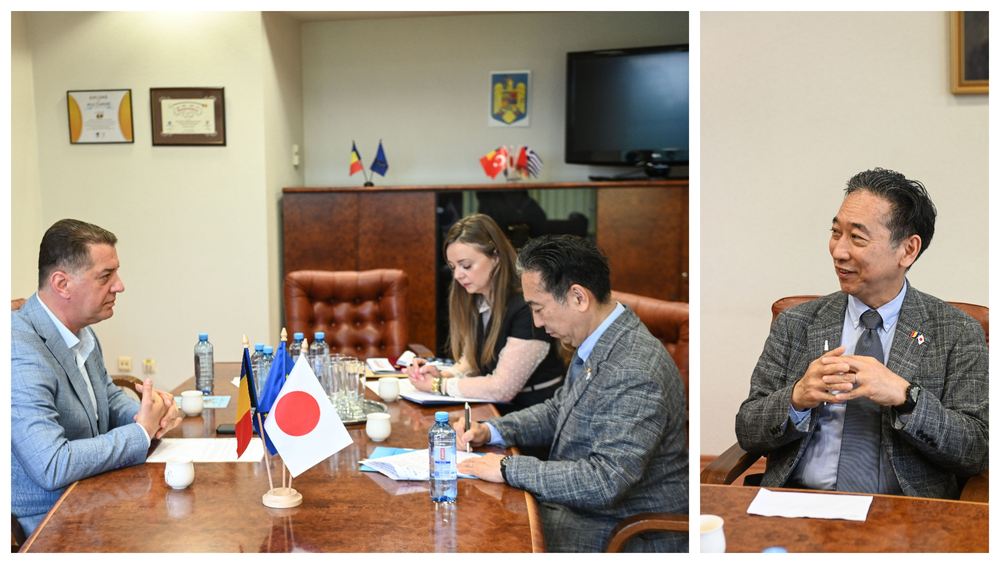
Present in Bacău for the eighth edition of the cultural program “Japan, Far Yet Close to Bacău,” His Excellency Mr. Takashi Katae, Ambassador of Japan to Romania, kindly granted an interview to Deșteptarea newspaper. He opened the conversation with the following message:
“First of all, I would like to thank you for giving me the opportunity to address the citizens of Bacău through this interview.”
– Your Excellency, Japan is often perceived as a civilization that successfully balances tradition and cutting-edge modernity. What do you believe is the most important lesson that European societies, including Romania, can learn from Japan today?
– I believe the most valuable lessons we can learn from Japan are the culture of community cooperation based on civic spirit and mutual respect, as well as the attitude of accumulating small improvements over time—the concept of Kaizen, or continuous improvement, which is deeply rooted in Japanese organizational culture. Even in an era of rapid technological innovation, caring for others and considering the interests of society as a whole remain the foundation that enables a sustainable balance between progress and inclusion. At the same time, Japan learns a great deal from Europe. Acceptance of diversity, creativity, and openness to other cultures can only deepen through learning, dialogue, and mutual understanding.
– Although separated by thousands of kilometers, Romania and Japan seem to share a profound respect for memory, family, and heritage. How do you view the cultural closeness between the two peoples?
– Our two countries share many common values, including care for family, respect for the wisdom of our ancestors and local traditions, as well as an appreciation for nature and the changing seasons. We also share a culture of politeness and hospitality, which can be observed even in martial arts and contact sports, as well as respect for craftsmanship and traditional arts such as wood carving and embroidery. Of course, there are differences in history, religion, and social systems, but these are not barriers; rather, they are opportunities to learn from one another’s strengths. I hope this closeness will continue to develop through cultural exchanges and cooperation in the field of education.
– Our event takes place on International Children’s Day. In a world dominated by technology and rapid change, what role do culture, museums, and education still play in shaping younger generations?
– Culture, museums, and education are indispensable in helping us navigate the wave of change you mentioned. Culture provides identity and meaning, while museums serve as spaces for dialogue, connecting the past with the present and local communities with the wider world. Digital technology expands experiences, and when combined with education that nurtures critical thinking and imagination, it becomes a powerful force that enables younger generations to shape the future with confidence and empathy. This Children’s Day event—“Japan, Far Yet Close to Bacău”—is an excellent opportunity to cultivate curiosity and creativity among children.
– Japan is admired for its social discipline and respect for shared public spaces. Do you believe these values can also be transmitted through culture and cultural diplomacy?
– Yes. Culture and cultural diplomacy are highly effective ways of naturally sharing values such as respect for social norms and public spaces. Good manners, cleanliness, punctuality, and consideration for others cannot be imposed by force; they are transmitted through concrete experiences such as joint projects, exchange programs, and mutual visits. Collaboration among artists, students, and local communities has the power to convey values more effectively than words alone.
– Your Excellency, Japan has offered the world one of the most remarkable examples of modernization without abandoning national identity, with the Meiji era often cited in this regard. At the same time, the world continues to admire Japan’s discipline, respect for education, and the moral code symbolically associated with the samurai ethos. How does contemporary Japan maintain a balance between tradition and modernity in an age dominated by globalization and technology?
– The essence of Japan’s contemporary balance lies in integrating universal and enduring values with current trends. Great importance is placed on preserving what is essential while boldly updating technologies and forms of expression. Examples include the protection of tangible and intangible cultural heritage, the transmission of local wisdom, innovation in the design of traditional crafts, and the modern revitalization of festivals and performing arts. At the same time, Japan promotes digitalization and human-centered technologies, improving the quality of healthcare, education, and public services. This balance is supported by a culture of consensus that harmonizes diverse opinions and by a social environment that encourages experimentation.
– In closing, and thanking you for this opportunity, I would like to ask: what Japanese proverb would you like to share with Romanians as a piece of advice, a lesson, or a source of reflection?
– I am not sure whether what I am about to say can strictly be called a proverb, but its message is this: “Ichigo Ichie” (一期一会). A possible translation into Romanian would be: “Make the most of every moment in life to become a better person. Otherwise, we risk missing opportunities that will never come again.”
– Your Excellency, Mr. Ambassador of Japan to Romania, thank you for your time and for this inspiring message in support of wisdom, knowledge, and cultural diplomacy.
Interview conducted by Alin Sebastian Popa.