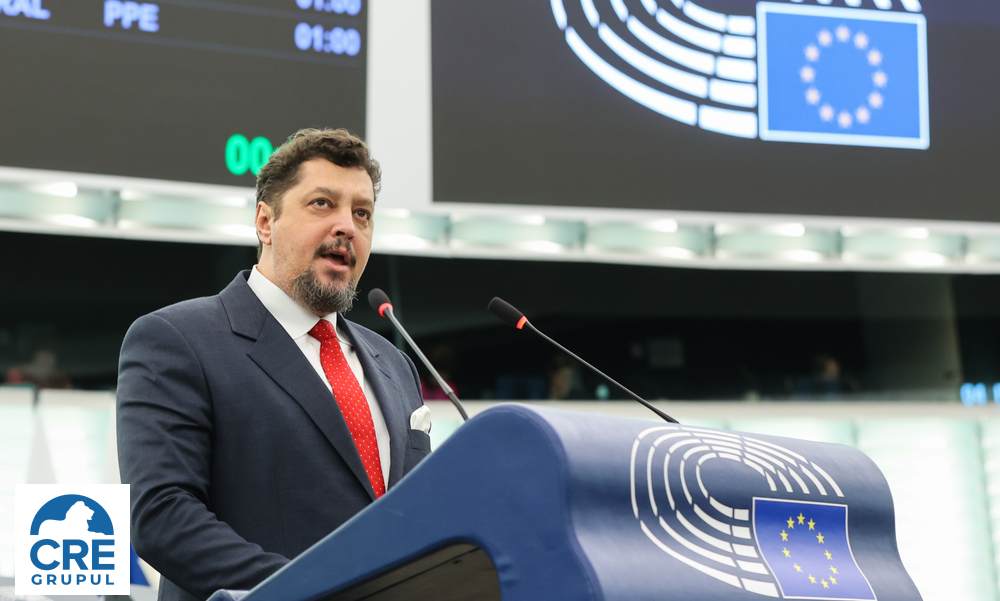
Claudiu-Richard Târziu, ECR Member of the European Parliament, recently addressed five questions to European Commissioner for Democracy, Justice, Rule of Law, and Consumer Protection Michael McGrath, within the Special Committee on the European Democracy Shield, where he serves as a substitute member. The objective was clear: to obtain clarifications on how the Commission uses the EU budget to intervene in areas that, according to the treaties, should remain under the competence of member states.
The MEP’s questions focused on five key issues:
Election, media, and civil society interventions – Târziu asked why the Commission is using EU funds in areas traditionally under the responsibility of member states, raising concerns about the centralization of powers not granted to it by the treaties.
Funding of NGOs and media outlets – He requested assurances that the so-called Democracy Shield funds would not be directed exclusively to organizations and publications supporting the Commission’s political agenda, marginalizing conservative voices critical of the EU.
Linking funds to the “rule of law” – Târziu warned about the risk that vague rule-of-law assessments could turn the EU’s financial mechanisms into a political tool, penalizing governments with views diverging from Brussels’ liberal ideology.
European Coordination Center Against Disinformation – The MEP sought guarantees that such a center would not be perceived as a censorship tool, but rather as a balanced mechanism respecting pluralism and freedom of expression.
MEDIA+ program – Regarding media support, Târziu asked how the Commission would avoid market distortion, ensuring that some publications do not receive direct financial advantages while others are excluded.
Following the meeting, Târziu noted that, although the Commission claims to defend democratic will and freedom of expression, Commissioner McGrath’s answers were general and did not address the concrete issues raised. “I have observed an increasingly clear tendency toward control and censorship, contrary to the principles the Commission claims to protect,” the MEP stated.
This situation raises questions about how the European Union manages funding and intervention in areas fundamental to national democracies, including media, civil society, and the protection of political pluralism.