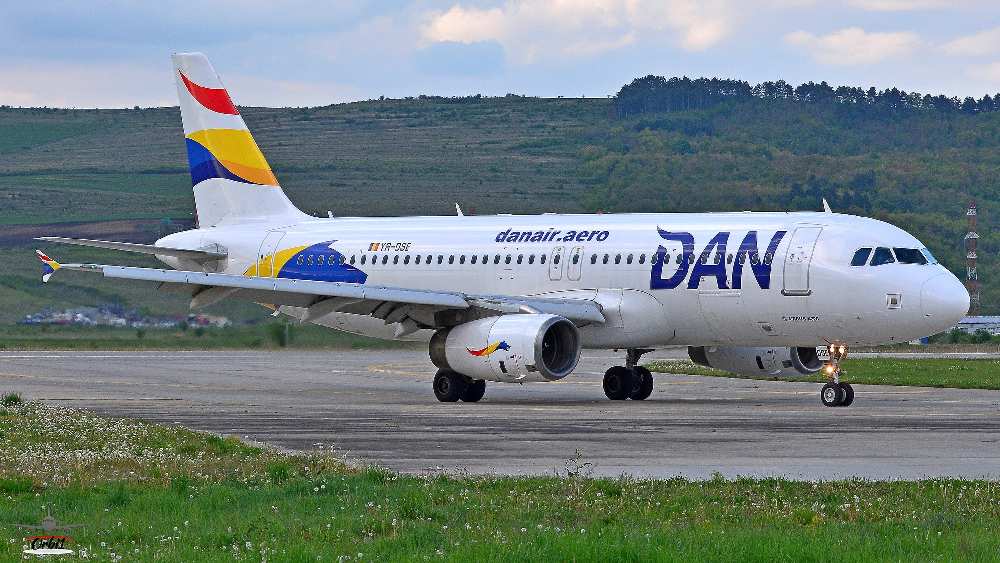
A Dan Air Airbus A319-100 was involved in a serious aviation incident on the night of December 1–2, 2025, during its approach to Bacău International Airport, after repeated navigation system anomalies caused the aircraft to deviate significantly from its intended flight path.
The aircraft, registered YR-URS, was operating flight DN402 from London Luton to Bacău. According to flight-tracking and post-flight data, the incident occurred during the descent and initial instrument approach phase, a critical stage of flight that requires high positional accuracy.
Navigation failures during critical phase
As the aircraft prepared for the ILS approach into Bacău, the flight crew received multiple ECAM alerts indicating “NAV GPS 1 and 2 FAULT,” signaling the loss of both onboard GPS navigation systems. With GPS unavailable, the aircraft reverted to alternative navigation sources.
Shortly thereafter, the crew identified that the aircraft was positioned approximately four nautical miles to the right of the localizer axis — a substantial deviation for a precision approach. While attempting to regain proper lateral and vertical guidance, the situation escalated when the Enhanced Ground Proximity Warning System (EGPWS) issued a TERRAIN alert, warning of a potential controlled flight into terrain.
In accordance with standard operating procedures, the crew immediately discontinued the approach, executed a go-around, and climbed the aircraft to flight level 110. Air traffic control provided radar vectors to safely reposition the aircraft, which subsequently landed on runway 34 without further incident approximately 25 minutes later.
Official investigation launched
Romania’s aviation safety authority, the Autoritatea de Investigații și Analiză pentru Siguranța Aviației Civile (AIAS), opened an official investigation, classifying the occurrence as a serious incident. The inquiry is expected to examine the simultaneous loss of GPS systems, the impact on aircraft positioning during approach, crew workload, and the precise sequence of events leading to the terrain warning.
Dan Air points to GPS spoofing
Separately, Dan Air published the findings of its internal safety investigation, stating that no permanent technical malfunction of the aircraft was identified. According to the airline, the event was triggered primarily by an external phenomenon known as GPS spoofing, in which false positioning data is transmitted to aircraft systems.
Dan Air linked the occurrence to the broader regional security context, noting that since the outbreak of the Russia–Ukraine conflict, parts of Eastern and Central Romania have been increasingly exposed to satellite navigation interference, including GPS jamming and spoofing.
The airline emphasized that this was the first such incident in its operational history since its establishment in 2017 and described it as an isolated event not reflective of its overall safety standards.
Timeline of events
According to Dan Air’s report, early signs of degraded GPS performance appeared at 23:32 UTC while the aircraft was cruising over central Romania. At 23:45 UTC, during descent, air traffic controllers informed the crew that the aircraft’s radar position did not match the cockpit-indicated position, with a discrepancy of approximately 3.5 nautical miles.
Despite this, onboard instruments continued to display seemingly valid data, delaying recognition of a navigation anomaly. At 23:55 UTC, as the aircraft approached the airport environment, the EGPWS terrain warning was triggered, prompting the go-around. The aircraft landed safely at Bacău at 00:20 UTC following a second approach under ATC guidance.
Contributing factors identified
Dan Air’s internal analysis cited a combination of contributing elements, including crew fatigue, challenging weather on previous sectors, increased workload due to a command line check, and a high degree of trust in GPS accuracy. The report also referenced confirmation bias, noting that the apparent normal behavior of the aircraft reduced suspicion that the navigation data itself was erroneous.
The airline confirmed that at the time of the incident the crew was fully licensed and fit for duty, the aircraft held valid airworthiness certificates, maintenance was up to date, and no deferred defects were recorded. No NOTAMs warning of GPS interference were in effect, despite similar phenomena having been reported by other operators in the region.
Safety measures implemented
While the internal investigation was conducted for preventive purposes and does not replace the ongoing AIAS inquiry, Dan Air stated it is fully cooperating with authorities. The airline has since introduced additional safety measures, including enhanced training on GPS spoofing and jamming scenarios, supplementary simulator sessions, and revised procedures for high-risk approaches.
The flight crew involved was temporarily removed from operational duties and underwent additional training before returning to line service.
“Safety is not a one-time objective, but a continuous process,” the airline said in a statement, reaffirming its commitment to strengthening operational resilience against emerging navigation threats.