
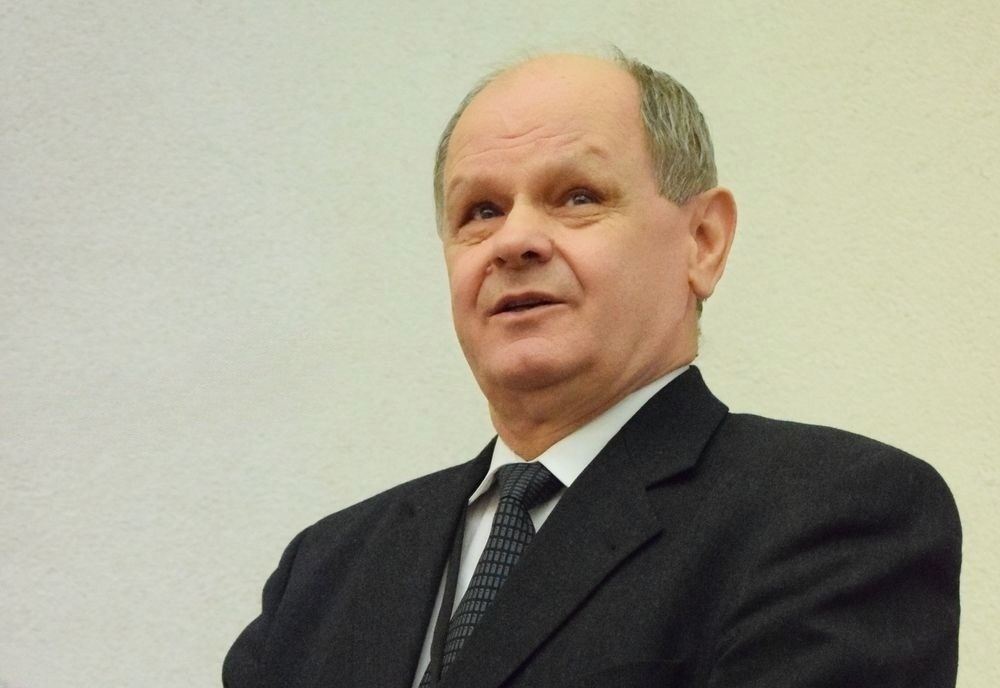
Professor Dumitru Bontaș, PhD, one of the founders of George Bacovia University in Bacău, former Prefect of Bacău County, engineer, researcher and academic, celebrated his 80th birthday by reflecting on nearly six decades of public service, higher education and Romania’s transformation. In an interview marking the occasion, he emphasized that lasting achievements are built not on ambition alone, but on enduring human values.
„I believe people can achieve exceptional goals if they know and respect a solid set of values,” Bontaș said, highlighting responsibility, prudence, loyalty, freedom, ethics, empathy and fairness as the foundations of a healthy democratic society.
Born on July 14, 1946, in Secuieni, Bacău County, Bontaș has witnessed Romania’s evolution from the final years of the monarchy through the communist era and into democracy and European integration. Looking back, he described Romania’s accession to the European Union as the country’s most significant transformation.
„The greatest change took place during the period of Romania’s integration into the European Union,” he said, noting that the democratic era has fundamentally reshaped Romanian society.
Although his career spans academia, engineering, industry and public administration, Bontaș said he never regarded personal accomplishments with pride, explaining that his upbringing taught him humility.
„I was educated in an environment where pride was considered a flaw in character. I believe I was fortunate because I always approached people with friendship and openness,” he said.
Bontaș served as Deputy Prefect of Bacău County between 1990 and 1992 before becoming Prefect from 1992 to 1996, during one of Romania’s most challenging periods of institutional reform following the fall of communism. He recalled that public officials had to continuously adapt to changing legislation while responding to citizens’ expectations and managing natural disasters such as floods and infrastructure failures.
According to Bontaș, successful public leadership requires balancing legal responsibilities with flexibility and responsiveness during periods of profound political and social transition.
A defining chapter of his career was the establishment of George Bacovia University, one of Romania’s first accredited private universities. He explained that the initiative emerged in the early 1990s with the support of respected academics from Iași, but faced considerable legal and institutional obstacles as Romania developed its accreditation system for private higher education.
At one point, more than 200 private universities had been established nationwide before stricter accreditation legislation reduced that number dramatically. Bontaș credited the success of the university to collaboration between academics, local authorities and private partners who helped develop the institution’s permanent campus.
Reflecting on today’s students, Bontaș expressed optimism about younger generations. He argued that advances in artificial intelligence and digital technology have given students unprecedented opportunities for lifelong learning and professional development.
„I believe young people who successfully complete their education have nothing to lose,” he said, adding that education now offers greater flexibility for those willing to adapt and pursue new career opportunities.
At the same time, he warned that education systems must evolve alongside technological progress.
„Education must keep pace and synchronize with all the changes generated by technology and artificial intelligence. Ignoring this principle could leave our country behind internationally,” he said.
Asked about today’s increasingly polarized political climate, Bontaș drew on historical experience, warning that political extremism has repeatedly produced devastating consequences for societies and public administration.
He argued that politics and public administration remain attractive fields, but can only serve society effectively when practiced intelligently by competent individuals chosen through democratic elections.
Throughout his academic career, Bontaș authored more than 20 books and university textbooks, published over 100 scientific papers and obtained 16 invention patents, several of which received international recognition. He has represented Romania at scientific conferences across Europe, North America and Asia while contributing to both engineering sciences and public administration.
His career also includes positions as university professor, department chair, chief engineer in industry, vice-rector and member of the leadership of George Bacovia University, where he helped shape one of eastern Romania’s most important private higher education institutions.
As he enters his ninth decade, Bontaș says his message to future generations remains simple.
„People can achieve exceptional objectives if they build their lives upon responsibility, ethics, loyalty, empathy and the other fundamental values that sustain a democratic society,” he concluded.