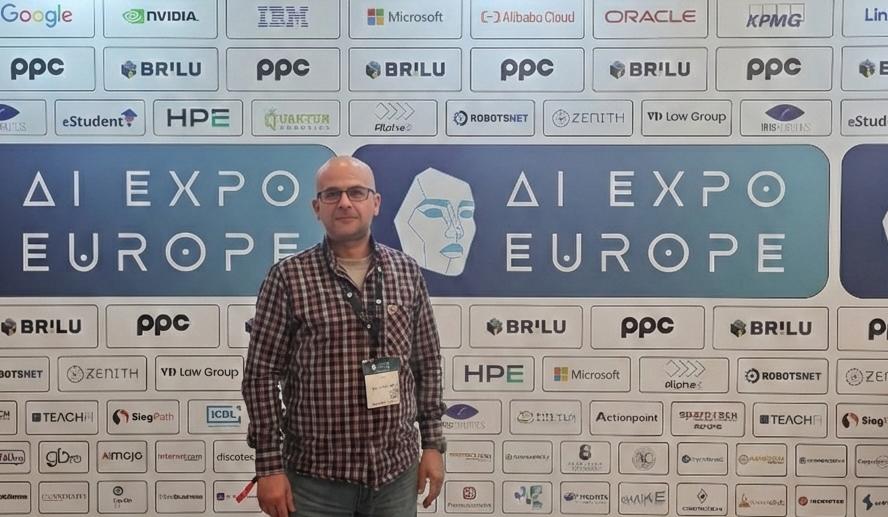
Two IT specialists from Bacău are bringing Romania into the spotlight of European technological innovation after winning funding for a project that will test advanced geographic artificial intelligence solutions designed within the European Commission’s ecosystem.
The project, titled “GeoEDUHealth Access – Bacău: Validation of JackDaw GeoAI for Territorial Accessibility Analysis in Rural Areas of Romania,” is coordinated by Constantin Avramescu, founder of the IT company MEDIA TREND, and IT specialist Alexandru-Norbert Droiman. It was selected for funding under the ENHANCE Call, part of the Horizon Europe research and innovation programme.
The competition was highly competitive, with more than 200 applications submitted across Europe. Only seven projects were selected for funding, and the MEDIA TREND proposal was the only one from Romania to win support, ranking second in the final evaluation.
“This success confirms our ability to design innovation projects with European-level impact,” said Alexandru-Norbert Droiman. “The fact that we managed to propose a relevant use case for an advanced tool like the JackDaw agent and be selected in such a competitive call shows that applying technology for civic purposes is the right direction.”
The project will test the JackDaw GeoAI agent, a geographic artificial intelligence tool developed within the European Commission’s technological ecosystem for analyzing geospatial data and optimizing public services. The Bacău team did not develop the technology itself, but proposed a real-world scenario to validate its practical applications.
The implementation will focus on three key areas considered essential for rural communities: education, school transportation, and access to healthcare services.
In education, the project will analyze the school network to identify ways to improve students’ access to educational institutions. At the same time, the technology will model more efficient school transportation routes, aiming to reduce travel time for students and decrease territorial inequalities. The analysis of access to healthcare services will also provide local authorities with valuable data for planning investments and improving medical services in rural areas.
“The stakes of this project are twofold: on one hand we validate an artificial intelligence model in real-world conditions, and on the other we demonstrate how heterogeneous data can be securely integrated to generate actionable intelligence,” said Constantin Avramescu. “From the perspective of a systems engineer with experience in cybersecurity, this project is an opportunity to build a robust architecture that could become a model for future AI implementations in the public sector, where data integrity and security are essential.”
Project initiators believe that testing the European GeoAI tool in Bacău County could transform the region into a pilot example of best practice in the use of artificial intelligence for public policy.
In the long term, the project’s results could generate strategic recommendations for public administration and allow the model to be replicated nationwide, contributing to the development of a data-driven, transparent, and efficient administration aligned with Europe’s digital transformation objectives.