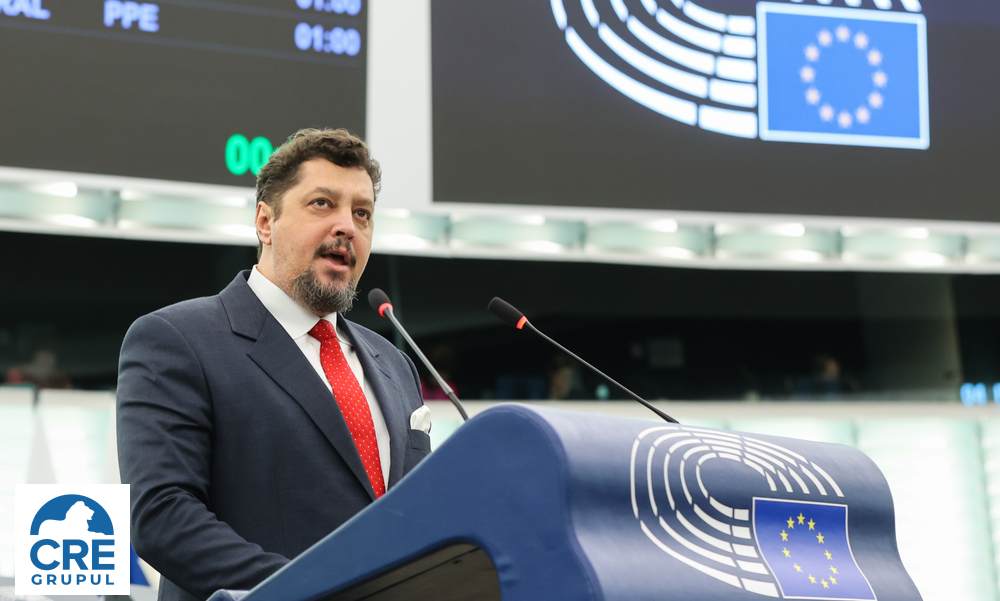
Claudiu-Richard Târziu, an ECR Member of the European Parliament, addressed the plenary session of the European Parliament in Strasbourg during a debate on the impact of the geopolitical situation on European patients and their access to medicines. The Romanian official drew attention to a major vulnerability of the European Union: its structural dependence on external markets for the supply of essential medicines.
In his speech, Claudiu Richard Târziu stressed that Europe’s health security is seriously affected by the current geopolitical context, given that active pharmaceutical ingredients are sourced largely from China and India. This reality turns European patients into “passive actors” in the face of disruptions and bottlenecks in global supply chains, with direct consequences for access to life-saving treatments.
The MEP referred to the European Pharmaceutical Package launched by the European Commission in response to medicine shortages. While the document officially acknowledges the existence of this crisis, Claudiu Richard Târziu argued that the proposed measures are insufficient and fail to address the root causes of the problem.
“The fundamental causes of shortages are not being resolved: excessive costs and increasingly burdensome administrative regulations have driven pharmaceutical manufacturers to relocate production capacities to less restrictive regions,” he explained to fellow MEPs.
In his view, without a clear strategy to encourage the return of pharmaceutical production to EU territory, the Pharmaceutical Package will bring neither real benefits for patients nor an increase in Europe’s medical security.
In a critical remark targeting ideological approaches, Claudiu Richard Târziu concluded that progressive policies cannot replace concrete solutions in the field of health. “If progressive doctrine could cure medical conditions, the European Union would have the healthiest citizens in the world. But in the real world, we are obliged to prioritize life, not ideological utopias,” the Romanian MEP stated.
His intervention brings back to the forefront the need for a pragmatic industrial and health policy capable of reducing external dependencies and protecting the health of European citizens in an increasingly unstable geopolitical environment.