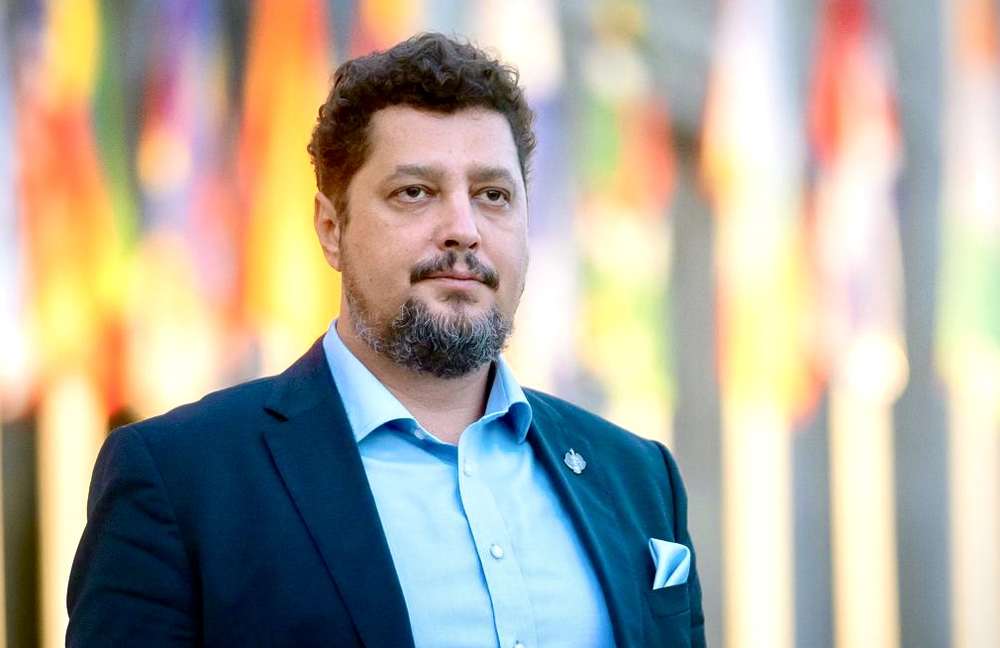
Claudiu-Richard Târziu, Member of the European Parliament representing the ECR Group, has delivered a firm message in defense of traditional values and freedom of expression. Emphasizing that “the truth must be spoken with courage,” he invoked the example of “witnesses of faith who became saints in prisons” as a moral guide in his public mission.
“Their example has guided me in defending fundamental values — family, faith, and the Romanian nation. The 2018 marriage referendum, made possible by the Coalition for the Family, was just one of the important battles we fought. I will not stop,” Târziu stated.
The MEP warned about what he described as a growing restriction on free speech and “increasing pressure on those who defend the natural values of society.”
“The chain is tightening more and more, and freedom of expression is increasingly under threat. We live in times when normality itself has become an act of courage, and the Constitution — the last line of defense,” Târziu declared.
As an example, he pointed to Slovakia, where a recent constitutional amendment “reaffirms biological reality and defends national interest.” According to him, a similar debate should take place in Romania.
“This discussion must happen without fear of labels or pressure from Brussels. Defending normality is not extremism. It is the duty of each of us,” Târziu said.
His remarks come amid intensifying debates across the European Union on redefining traditional values and balancing national legislation with EU directives.
Târziu’s statements reflect growing political tensions between European institutions promoting expanded human rights frameworks and national movements seeking to preserve what they define as “traditional social structures.”
This issue has sparked polarized reactions in multiple member states, with some governments supporting measures similar to Slovakia’s, while others emphasize alignment with EU human rights standards.
In Romania, the debate around family, identity, and national sovereignty continues to divide public opinion, suggesting that the topic will remain a flashpoint in both political and cultural discourse.