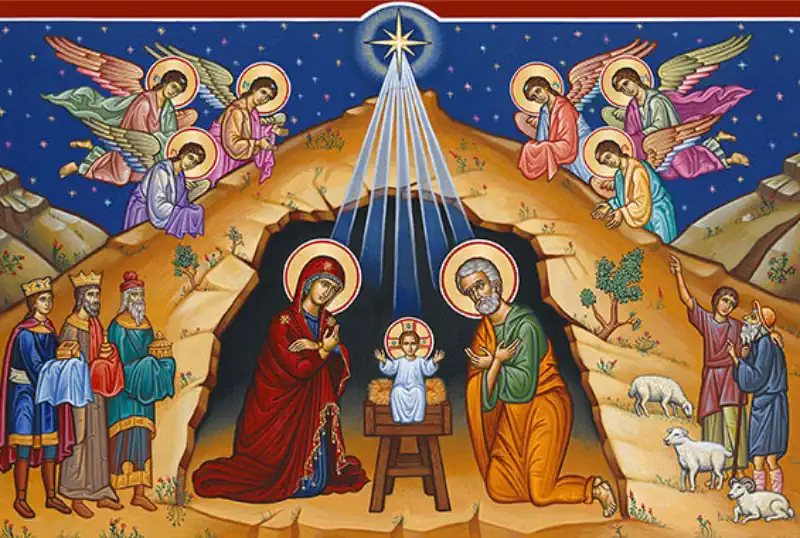
Among all winter holidays, Christmas holds a special place in people’s hearts, being the most eagerly awaited and the most deeply charged with spiritual meaning. For Christians, 25 December marks the Birth of Our Savior Jesus Christ, an event that symbolizes not only the coming of light into the world, but also a profound spiritual rebirth. It is a moment when faith, hope and love come together in perfect harmony.
Christmas reawakens the emotional memory of childhood, bringing back to the forefront images filled with charm: abundant snowfalls, seen as a sign of a fertile year, carols echoing from gate to gate, the ringing of bells, the scent of fresh fir trees and the aroma of sweet bread just taken out of the oven. The anticipation of gifts beneath the decorated tree creates a fairy-tale atmosphere in which inner peace and shared joy become essential. All these elements make up the symbolic universe of Christmas, as also captured in the volume Cartea de Crăciun (The Christmas Book) by Sorin Lavric.
In traditional Romanian culture, Christmas is not merely a feast, but also a complex character with dual traits. It combines supernatural attributes, specific to gods and mythical heroes, with human weaknesses and virtues. In its profane guise, Moș Crăciun appears as an elderly shepherd, with a beard as white as snow, the neighbor and elder brother of Moș Ajun. Under the influence of Christianity, the character acquires apocryphal meanings: he is considered older than the saints and the master of the shepherds in the village where Christ was born.
The legends of the Nativity place the action in a pastoral village, where Moș Crăciun, a wealthy man, owned vast households and numerous herds. The unexpected arrival of the Virgin Mary, on the brink of giving birth, disrupts the tranquility of this place. Moș Crăciun’s initial refusal to offer her shelter and his punishment of his wife, Crăciuneasa, for helping the stranger underline his harsh and unyielding nature. Yet the moment of revelation—the discovery that Jesus was born in his stable—triggers his repentance and spiritual transformation. Thus, Moș Crăciun becomes the first Christian and a symbol of conversion and forgiveness.
With the spread of Christianity, the figure of Crăciun could not be entirely removed from the Folk Calendar, being too deeply rooted in the collective imagination. Over time, traditions were enriched, and the image of the stern old man gradually transformed into a gentle and generous one, also influenced by modern literary sources.
Throughout all regions of the country, Christmas is marked by ancient ritual practices, at the center of which stand caroling and festive meals. Carolers proclaim the Birth of the Lord and bring wishes of abundance, health and peace, while the Christmas table becomes an occasion for communion and togetherness.
Last but not least, Christmas is considered the celebration of the family. It is a time for reunions, for gifts offered from the heart, and for moments spent together around the table or the Christmas tree. By honoring traditions and experiencing this holiday authentically, people express their belief that the coming year will be better, richer and brighter.