
Almost 2,000 years have passed… Have people changed in any meaningful way? If we look at buildings, scientific discoveries, and the many elements that “allow” us our daily comfort, we could confidently say that humanity and society have evolved. And since this word implies that people are on an upward trend, one might think humanity is close to reaching perfection.
Unfortunately, reality is far from this carefully maintained illusion. Our entire civilization (and I mean human civilization in its entirety) resembles a beautiful tree that seems to have everything, but when you look closer you notice it bears no fruit, and the little ants that inhabit it lack wisdom. Like creatures driven by frenzy, they gather and gather and gather, yet the lamp of the soul lacks the oil of good deeds.
A unique calendrical and liturgical period within the Christian Orthodox Church, Holy Week (or Great Week) draws us into a very special atmosphere, woven with prayer and restraint. It marks numerous events concentrated in a short historical interval that, both temporally and spiritually, encompasses the entire existence of humanity.
The Feast of Palm Sunday, through the stark contrast between the joy of welcoming the “teacher and healer” and His subsequent arrest, awakens us from the dreamy state stirred by the crowds’ cries: “Hosanna, Son of David!” Likewise, Christ’s triumphant entry into Jerusalem—yet riding on a donkey’s colt—emphasizes humility and symbolizes the return of the unruly nations from unbelief to faith.
Each day of Holy Week reminds us and helps us relive the final days of the Savior’s life, with the thought that these should also become the last days of our life bound to sin, and with the hope that Christ’s Resurrection is the first step toward our own resurrection.
Holy Monday
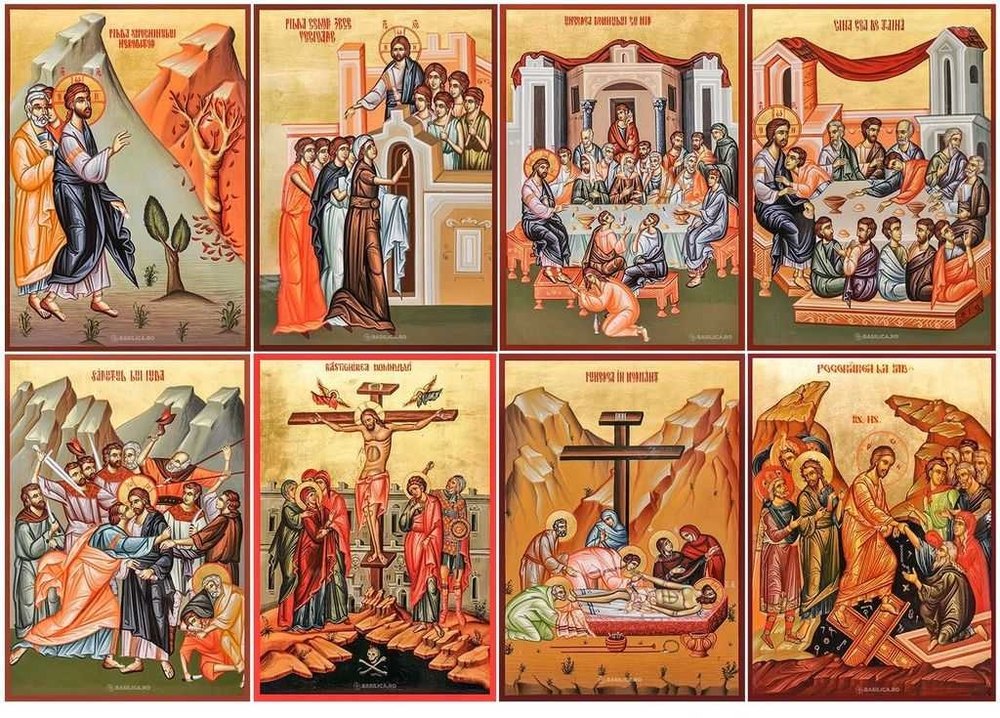
On Monday of Holy Week, the Church commemorates Patriarch Joseph, who was sold by his brothers for thirty pieces of silver. Joseph the All-Beautiful—the youngest son of Patriarch Jacob—prefigures Christ, because just as Joseph was envied and betrayed, Christ too was envied by the Jews, sold by His disciple for thirty pieces of silver, and placed in the dark pit of the tomb. Rising from there by His own power, He reigns over Egypt—that is, over sin—defeating it and, as a lover of mankind, redeeming us and feeding us with heavenly bread.
On this same day the Church also remembers the barren fig tree cursed by Christ because it bore no fruit. It is a lesson for mankind: God is both love and justice. At the Last Judgment, He will not only reward but also punish those who have borne no fruit. A Christian must produce fruit—fruits that are good deeds, sacrifice, self-denial, obedience to commandments, and the striving for love.
“Enlighten the garment of my soul, O Giver of Light, and save me.” (Kontakion of the day)
Holy Tuesday
On Tuesday we remember the Parable of the Ten Virgins, a reminder that we must live constantly in Christ. Christ told this eschatological parable so that no one, even if living in chastity (keeping one virtue), should neglect the others—especially charity, through which the brightness of chastity is revealed. Christ must be present in each of us at every moment through piety accompanied by mercy.
The Parable of the Talents, also recalled on this day, complements the previous one: our gifts—whether talents (natural inclinations toward an art or craft) or virtues (steady efforts to cultivate moral goodness)—must be put to use within society and not hidden or left unfruitful.
Holy Wednesday
On Wednesday we commemorate the sinful woman who washed Christ’s feet with her tears and anointed them with myrrh before His Passion, symbolizing repentance and the correction of a sinful life. She did what the myrrh-bearing women intended to do after Christ’s burial. Burning with the desire for forgiveness, she cried: “Untie my sins, as I have untied my hair.”
This day includes the final Liturgy of repentance, sealing the entire spiritual work of the Lenten fast. The contrast between the sinful woman and Judas is striking: she stands at the lowest point of moral fall, while Judas stands in the highest honor as Christ’s disciple. Repentance lifts the woman up and makes her a myrrh-bearer; the lack of repentance casts Judas down, making him a traitor who ends in despair.
Holy Thursday
Holy Thursday commemorates four events from Christ’s life:
- The washing of the disciples’ feet, a supreme example of humility.
- The Last Supper, when Christ instituted the Holy Eucharist.
- Christ’s prayer in the Garden of Gethsemane, a moment of profound suffering and obedience.
- The betrayal and arrest of Christ, marking the beginning of His Passion.
At the Last Supper, Christ says:
“Take, eat; this is My Body… Drink of it, all of you; this is My Blood…”
In Holy Communion Christ gives Himself to us under the form of bread and wine, “for the forgiveness of sins and eternal life.”
Great and Holy Friday
On Great Friday, we commemorate the holy, saving, and fearful Passion of Christ and the confession of the grateful thief who gained Paradise.
Christ’s sufferings are called holy because the One who suffers is the Son of God; saving because His sacrifice redeems humanity from sin; and fearful because all creation trembled at His crucifixion:
“The sun was darkened, the earth shook, and many of the dead were raised.”
The Cross becomes the altar of sacrifice on which Christ offers Himself for the redemption of humanity and the sign of His victory over death.
Great and Holy Saturday
On Holy Saturday, we celebrate Christ’s burial and His descent into Hades, where He raises those who had fallen asleep since the beginning of time.
This day of “rest in the tomb” is one of deep silence and sorrow. Even the bells are silent. All creation mourns and hopes at the same time—mourning our sin and weakness, yet hoping in the Resurrection born from the immeasurable love of the Holy Trinity for all creation.
During Holy Week we are called to live a present that leans toward the future—a present of fasting and prayer that offers the opportunity for spiritual growth. If we have confessed during the forty days of Lent before Palm Sunday, we can naturally connect with the events we commemorate, humbling ourselves, removing the thorns of pride and passion, and allowing divine grace to work through us for the restoration of the whole world.
We live in times when wars, rumors of wars, illnesses (especially depression), and the threat of crises—food, energy, technological, but especially spiritual—make many believe that the End is near. It is natural, therefore, to be concerned with our personal “apocalypse” and to ask what worthy deeds we can perform so that the time of our life here may be well spent.
If we were alone, everything around us would turn “gray, dull, and meaningless.” Fortunately, we have people beside us—people who wish to be part of this great puzzle of life on earth, aware that only together do we form the Whole that allows us to remain in the Joy, Peace, and Love of the Good God, One in Essence and Three in Persons: the Father, the Son, and the Holy Spirit.
Blessed and peaceful Easter celebrations!
Ioan Deacu