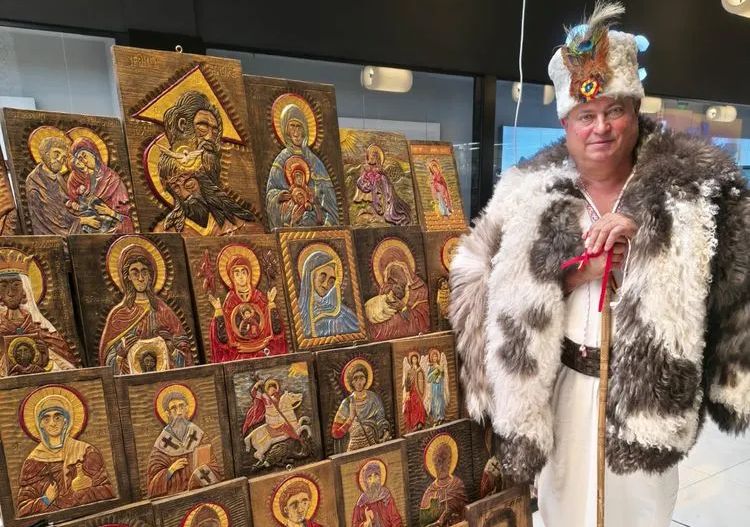
By sheer coincidence—or perhaps not—my recent travels, through the country or across the city, have once again brought me face to face with Rodion Stoian, the craftsman from Bacău known far and wide as “The Man with the Icons.” I first met him back in 2019, when I visited his small creative workshop tucked away in the basement of a block on Bicaz Street. Just a few days ago, as Bacău celebrated its 617th anniversary, we met again at a traditional crafts fair held in a shopping center on the city’s outskirts.
Truth be told, I was looking for him. We had run into each other by chance this September at a fair in Bucharest organized by the Ministry of Agriculture. It was a perfect occasion to chat and take some photos together—both of us wearing sheepskin coats hand-stitched by him, to the delight of passers-by. As Rodion later told me, those very coats found buyers soon after I posted the pictures. And no wonder—they were beautiful. But coats are only a small part of what “The Man with the Icons” creates, all entirely handmade.
He crafts bondițe (sheepskin vests), fur hats, Dacian-style caps, leather sandals, belts, traditional girdles, drums, animal horns for blowing, whips, wooden icons—and much more. Everything he makes exudes authenticity, the kind that makes you stop in your tracks just to admire it.
The Story
As the craftsman himself told me recently, “My story is still the same,” so here are a few excerpts from it.
Rodion Stoian studied in his home village of Horgești up to the 10th grade. “I even had a merit scholarship—440 lei a month—because my grades were above 8,” he recalls. He was supposed to become a priest, but after high school he tried to become a professional driver and failed the psychological test.
In the late ’70s, he worked in Bucharest as a carpenter. “I was so far from home—it felt like being in the United States today. I was the first child in the family to leave home, and it was tough,” says Stoian, who eventually returned closer to home, to Onești. There he took qualification courses and worked as a petrochemical operator.
After a while, he joined the army, and when he finished his military service, he settled in Bacău, finding work at the Letea factory, where he remained until 2001. “In 2001, I too left for Italy—like every Romanian back then. I said I’d go for six months, make some money, and buy a new car, because I had an old Dacia wreck. It was fine for its time, but I wanted something better,” he laughs.
But, as he puts it, “things don’t always go as planned.” “After two years in Italy, I didn’t even have 200 dollars to my name. I don’t know how others managed to make 8,000 or 10,000 dollars. I worked honestly, but I couldn’t do it,” Stoian admits.
He returned home in 2009, only to face new hardships: his wife’s health problems. That difficult time opened him up to faith—and to icon carving. “I can’t say I discovered this side of me, because I was already a sculptor by trade. The first icon I made—I still have it, and I take it to every fair I go to,” says Stoian.
He remembers exactly how it began: “I was at church, kneeling in prayer. Suddenly, I had a kind of revelation. I looked at the icon of the Virgin Mary in the narthex and thought—why couldn’t I make one like that? The next day, since I had no materials, I went to the big market and bought a cutting board from a spoon-maker from Mărășești. That cutting board became my first icon. It happened on July 24, 2015.”
America Remains Far Away
Nowadays, Rodion Stoian spends almost every weekend at traditional festivals and craft fairs, having become a familiar and beloved figure on the folk-art scene. At one point, he was even invited to Sacramento, California, to showcase his creations to the Romanian community there.
“They have to bring something truly Romanian—not cheap imitations. And here in Bacău, no one else makes what I make,” he said at the time. But then the pandemic hit, and all those plans vanished.
A Familiar Face at Fairs Across Romania
The years have passed, but “The Man with the Icons” continues to travel from fair to fair. He’s invited everywhere—and in some towns, organizers even offer him free accommodation just to have him participate.
“People come, they look, some even buy. Others just come as if to a museum. But that’s fine too. I make everything by hand and with great joy. I also give small gifts to children—they’re so happy. That’s how I pass on a little piece of our ancestral culture,” says Stoian. He even chuckles, recalling a few Romanian kendamas he once made—crafted from a wooden spoon, a string, and a walnut.
If you haven’t yet seen the wonderful creations of “The Man with the Icons,” you really should. You’ll be glad you did. And this coming weekend, you can find the Bacău craftsman, Rodion Stoian, at the “Sheep Festival” in Slănic Moldova.