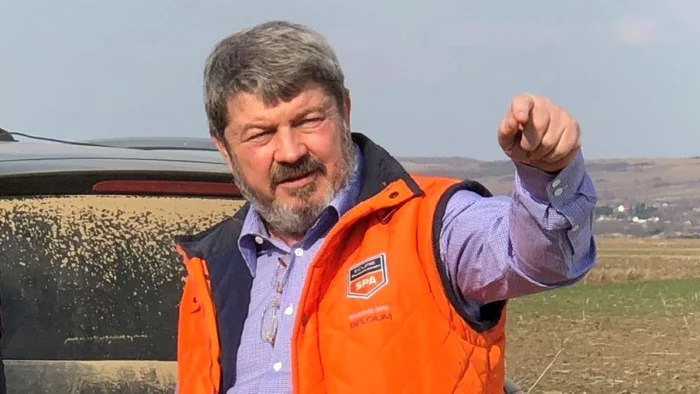
Romanian entrepreneur Dorinel Umbrărescu, best known for building some of the country’s largest motorway projects, is expanding his business interests into heavy industry and energy, acquiring former steel plants and other industrial assets in an effort to revive production.
The moves involving steel plants in Oțelu Roșu and Hunedoara, UMB’s interest in the Liberty Galați steelworks and its recent acquisition of the Halânga thermal power plant point to a broader industrial strategy that is taking the UMB group beyond road construction.
UMB has become one of Romania’s largest motorway contractors in recent years. Alongside its construction projects, however, the group has increasingly focused on acquiring industrial assets that have been closed or are operating far below their former capacity.
Oțelu Roșu: rebuilding a closed steel plant
The first major step came with the acquisition of the industrial platform at Oțelu Roșu in Caraș-Severin county.
The Umbrărescu family acquired the assets through Eco Wind Power for approximately 141.65 million lei. The steelworks, whose industrial history stretches back more than two centuries, had been shut down since 2012.
Rather than dismantling the platform and selling its assets separately, the new owner has begun preparing the site for a potential restart of production. Equipment is being dismantled and relocated, new production areas are being prepared and a new technological flow is being developed.
The investment is estimated at several hundred million lei.
The planned facility would use an electric furnace and modern casting and rolling technology, with an estimated production capacity of around 700,000 tonnes per year. Planned products include bars, compact coils and wire rod, materials widely used by the construction industry.
The project could also create an important internal supply chain for UMB, one of Romania’s largest consumers of construction materials.
Hunedoara becomes the group’s second steel platform
In December 2025, UMB Steel signed an agreement in principle to acquire the assets of ArcelorMittal Hunedoara for 12.5 million euros plus VAT.
The transaction included land, buildings, equipment, installations and stocks. Steel production at Hunedoara had been permanently halted earlier in 2025.
Following approval by Romania’s Competition Council, Hunedoara became the second major steelmaking platform to enter the Umbrărescu group’s portfolio.
While Oțelu Roșu is being approached primarily as a restart project, Hunedoara currently represents an expansion of the group’s industrial asset base.
Liberty Galați remains a major target
The biggest potential acquisition, however, is Liberty Galați, one of Romania’s largest steelmaking facilities.
UMB Steel is among the investors interested in acquiring the plant. After two auctions in 2026 failed to attract buyers, the sale process moved towards direct negotiations, with Umbrărescu’s company competing against major international steel industry groups.
A successful acquisition would significantly increase the scale of UMB’s industrial operations. Unlike Oțelu Roșu, which has been closed for more than a decade, Galați is one of Romania’s major integrated steelmaking platforms.
For now, however, UMB Steel remains only one of the potential buyers and the sale process has not been completed.
From steel to energy
The group’s latest move takes it into the energy sector.
In October 2026, companies controlled by Umbrărescu won the auction for the Romag Termo Halânga thermal power plant in Mehedinți County.
The industrial platform covers more than 76 hectares and includes land, buildings and equipment. The power plant was built in 1981 and had an installed capacity of 247 MW before being permanently shut down in 2015.
The acquisition gives the group a foothold in an area that is particularly important for energy-intensive industrial operations.
A strategy of vertical integration
Taken together, the acquisitions suggest a strategy of vertical integration.
Road construction requires large quantities of steel, metal products, aggregates, concrete and energy. Controlling part of the steel supply chain could allow UMB to produce materials required for its own construction operations, while access to energy assets could provide another element of control over the group’s industrial costs and supply chain.
The strategy is particularly notable because of the type of assets Umbrărescu has been acquiring.
Oțelu Roșu stopped production in 2012. Halânga was shut down in 2015. Hunedoara ended steel production in 2025, while Liberty Galați is currently seeking a new owner after facing financial difficulties.
In effect, the businessman from Bacău is investing in industrial assets left behind by previous owners as Romania’s heavy industry has contracted dramatically over the past decades.
The strategy carries significant financial and operational risks. Restarting obsolete industrial platforms requires substantial capital, modernisation and access to competitive energy, while steel production is exposed to volatile international prices and intense competition.
But if the plans for Oțelu Roșu, Hunedoara and Halânga advance as intended, and UMB ultimately succeeds in acquiring Liberty Galați, Umbrărescu’s business empire could evolve into one of Romania’s most significant privately controlled industrial groups.
The entrepreneur became known for building Romania’s roads. His latest investments suggest that he is increasingly interested in controlling some of the industrial infrastructure and raw materials needed to build them.