Some stories do not end when a newspaper goes to print. They remain with you for years.
And sometimes, the people you meet while reporting a story become part of your life long after the article itself has been forgotten.
Dr. Maria Rusu is one of those people.
For more than a decade, every encounter with her has brought the same lessons: hope, perseverance, wisdom and dignity. There has always been a particular light in her eyes — the kind of light carried by people who seem never to grow old.
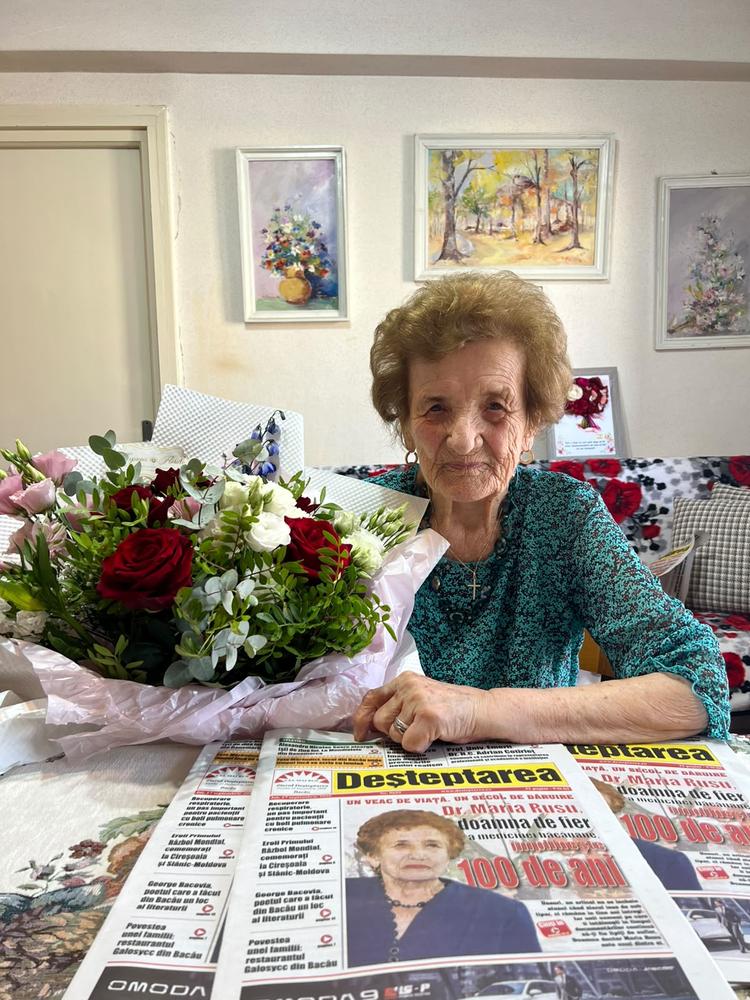
On September 17, 2026, Dr. Maria Rusu turns 100.
A century of life. A century that has taken her from a small village at the foot of the Ceahlău Mountains through war, poverty and hardship, to a distinguished medical career and a central role in the development of paediatric medicine in Bacău.
But numbers alone cannot tell her story.
The girl from the Bistrița Valley
Maria Rusu was born on September 17, 1926, in Hangu, in the Bistrița Valley, at the foot of the Ceahlău Mountains. She was the only child of Paraschiva and Vasile Onu, a modest, hardworking couple.
She knew remarkably early what she wanted to become.
At the age of three or four, she had already decided that she would be a doctor.
At 12, she left home on her own to continue her education in Piatra Neamț.
She was enrolled at the Normal School, following a path that might have seemed natural for a girl of her background. But it was not the path she wanted.
She wanted medicine.
She could not have known how much that dream would cost her.
The war entered her adolescence with frightening brutality. As a sixth-grade student, she experienced bombing raids and the presence of soldiers not as history taught in textbooks, but as immediate and terrifying reality.
During the armistice, she spent four days and four nights hiding in a forest, hungry and alone.
Then, in 1945, tragedy struck again. Her father died at the age of only 47, leaving the family without an income.
There followed years of hunger and poverty.
But the dream survived.
“I went to university like a leaf carried by the water”
In 1946, Maria travelled to Iași to sit the entrance examination for medical school.
There was no alternative career plan. Her mother worked to support her daughter, while Maria studied day and night.
Years later, she would describe the beginning of that journey with characteristic modesty:
“I went to university like a leaf carried by the water.”
Yet that “leaf” knew exactly where it wanted to go.
From her third year at medical school, she began working on a formal employment contract. She received a scholarship, accommodation, clothing and financial support, but perhaps most importantly, she gained practical experience — medicine learned alongside patients, rather than solely from books.
At the bedside of a sick child. In the operating theatre. In those moments when theory had to become action.
During her university years, she met Dr. Dumitru Rusu, a fifth-year surgery student who would later become her husband.
Maria graduated from medical school in 1952.
By then, she had already discovered where she belonged: among people, among children and among those who needed her.
One of her first major medical responsibilities involved an 18-year-old boy who had fallen from a tree, suffering a spinal fracture and paralysis.
The young man asked whether he would ever walk again.
For a doctor at the beginning of her career, the question was more than medical.
It was a question about hope, about life and about what a doctor is entitled to promise someone who is suffering.
The doctor who refused to accept poor conditions
Then came Bacău.
And with Bacău came another chapter in Dr. Maria Rusu’s remarkable story: the story of a hospital that she helped bring into existence because she understood that medicine cannot be separated from the conditions in which it is practised.
Her early years were difficult.
She worked at the dispensary in Șerbănești and at Bacău’s Children’s Hospital, housed at the time in a modest building with approximately 50 beds.
The conditions were extremely poor.
There was no sewage system. The kitchen was in deplorable condition. There was no oxygen supply.
In winter, what passed for oxygen therapy sometimes meant simply opening the windows wide to the freezing air outside.
As many as 15 children could be crowded into a single ward.
Water was heated outdoors over a fire and then carried into the wards so that the children could at least have some basic comfort.
Later, the hospital moved to the railway station area, into a building that had previously been used by the Securitate, Romania’s communist-era secret police.
Water was kept outside in barrels.
Mothers washed their children’s nappies and dried them around their waists, using their own body heat.
These were harsh times.
But Dr. Rusu did not accept deprivation as something inevitable.
She set out to change it.
Building a hospital
By 1958, Maria Rusu was director of the Children’s Hospital.
Almost immediately, she began working to establish a proper paediatric facility.
Bacău was a poor city with substantial medical needs. Children needed a hospital where they could be treated in decent conditions.
Dr. Rusu travelled to the Ministry of Health, held discussions, insisted, sought support and followed the project through.
She did all this while pregnant with her only child, Irina.
Three years later, in 1961, the new facility opened as part of the County Hospital, with 285 beds for children and another 65 for mothers.
That same year, Dr. Maria Rusu took the examination for the title of senior specialist physician and ranked third nationally.
Her career was no longer simply about treating patients.
It was about building.
A career measured in people
Dr. Rusu worked in paediatrics and served as head of department between 1974 and 1979.
She subsequently became director of the Bacău Health Directorate, a position she held until 1989, when she retired — just two weeks before the Romanian Revolution.
Throughout her career, colleagues remember her as rigorous, organised, energetic, punctual and fair.
She was known for arriving first and leaving last.
For her, young patients were never merely “cases”.
They were, in many ways, her children.
She also helped shape generations of medical professionals, working within numerous professional and administrative structures and taking on important responsibilities in the county’s medical system.
She worked alongside doctors who would themselves become part of what many remember as a golden era of Bacău medicine.
But positions and titles are not necessarily what remain.
People remain.
Former patients who recognise the doctor who cared for them when they were children.
Doctors who remember the first senior colleague who trusted them.
Nurses who remember where they learned their profession.
And a hospital that stands as part of the legacy she helped create.
Discipline, punctuality and humanity
Those who know Dr. Rusu often speak about her discipline.
There are clocks throughout her home.
Not simply because she likes to know the exact time, but because, for her, punctuality is a form of respect — respect for another person and respect for one’s word.
The principles she has carried throughout her life are simple: hard work, honesty, discipline, punctuality, fairness and humanity.
And perhaps that combination explains why so many people remember her not simply as a doctor, but as a force within the medical community.
A family of doctors
Medicine also became part of the Rusu family’s identity.
Her husband, Dr. Dumitru Rusu, was a surgeon.
Their daughter, Dr. Irina Mereuță, became a senior family medicine physician.
And their grandson, Alexandru Mereuță, grew up surrounded by doctors and by the example of his grandmother.
Irina remembers a mother who was constantly active — leaving home in the morning and returning in the evening after meetings, telephone calls, conferences and problems that needed solving.
Yet she never felt that she came second.
Medicine was a constant subject at the family table: cases, diagnoses and treatments.
It was not simply her parents’ profession.
It was part of their way of life.
Irina eventually chose medicine herself, influenced by her family but never pushed into the profession by her parents.
Today, she describes her mother as her first source of support, her confidante and the person she could always turn to.
For her grandson, however, Dr. Rusu was first and foremost his grandmother.
“God couldn’t be everywhere, so he created grandmothers,” he once said.
For him, she remains a blessing — someone who taught him to be fair, honest and hardworking, to help whenever possible and to remember that a person’s true measure lies in what they leave behind.
A living landmark of Bacău medicine
At the age of 87, during an interview I conducted with her on a Friday morning, Dr. Rusu said she felt 50.
Today, she is 100.
Perhaps if asked what has changed, she would simply say: time.
Because there are people who grow older in years and people who remain young through what they have done.
There are lives measured in birthdays, and lives measured in the people whose lives they have touched.
Dr. Maria Rusu’s life can be measured in children.
In doctors.
In generations.
In a hospital that became possible because she believed it should exist.
In the growth of Bacău’s medical community.
And in the people she helped, taught, encouraged or, when necessary, firmly put back on the right path.
It is sometimes said that a good doctor heals, while an exceptional doctor leaves something behind.
Dr. Maria Rusu has certainly left something behind.
At 100, her story is not simply that of a physician who lived through a century.
It is the story of a woman who crossed almost every great challenge her country could place in front of her: war, hunger, poverty, political change and profound transformations in medicine and society.
And she remained standing.
With the same energy.
The same discipline.
The same dignity.
From an interview to a friendship
More than a decade ago, I walked into Dr. Maria Rusu’s home as a reporter for the Romanian daily Deșteptarea.
I had a notebook in front of me and a long list of questions.
I had come to write about a doctor — her career, her achievements and her professional life.
I left with the story of an entire lifetime.
Years passed.
I no longer work for the newspaper where that interview was published. But the friendship remained.
We visited each other, spoke on the phone and met whenever time and life allowed.
Perhaps this is one of the most beautiful things journalism can give you: people who begin as subjects of a story and remain in your heart forever.
When I was asked to write about the day Dr. Maria Rusu turned 100, I immediately returned to that first meeting.
The reporter and the doctor.
Two generations.
Two worlds.
Time had moved far beyond that spring morning, but not the friendship.
And not the respect.
Because Dr. Maria Rusu is more than a distinguished physician.
She is a living page in the history of Bacău medicine.
More than a decade ago, I came to her home to conduct an interview.
Today, I return to tell the story of a century.
Between those two moments lie years, memories and a friendship I could never have anticipated when I first entered her home with a notebook, a pen and a recorder.
Journalism brought me to a woman I was supposed to write about.
Life gave me the privilege of remaining close to a woman I came to value enormously.
Today, I am not writing only about a doctor.
I am writing about a landmark.
A woman who knew from childhood what she wanted to become and never abandoned that path, no matter how difficult it became.
A doctor who understood that saving a child sometimes also means building a hospital.
A leader who could be firm without losing her humanity.
A wife, mother and grandmother who is deeply loved.
And a woman whose mark remains on the lives of countless others.
Thank you, Doctor
Dr. Maria Rusu, on your 100th birthday, I am not simply saying “Happy Birthday”.
I am saying thank you.
For the children you held in your arms.
For the doctors you helped shape.
For the hospital you helped make possible.
For the people you helped.
For showing that discipline can coexist with humanity, and firmness with kindness.
And for something I could never have anticipated when I was simply a reporter: the friendship that began with an interview and became something I have treasured for many years.
Happy 100th birthday, Doctor Maria Rusu.
Deșteptarea thanks you for allowing its pages to honour your work, your contribution to Bacău’s medical community and the good you have brought to the people around you.
A century of life.
A century of dedication.
And a story that, fortunately, does not end here.